“Philosophia Perennis—the metaphysic that recognizes a divine Reality substantial to the world of things and lives and minds; the psychology that finds in the soul something similar to, or even identical with, divine Reality…”
—Aldous Huxley’s introduction in his 1944 book, The Perennial Philosophy
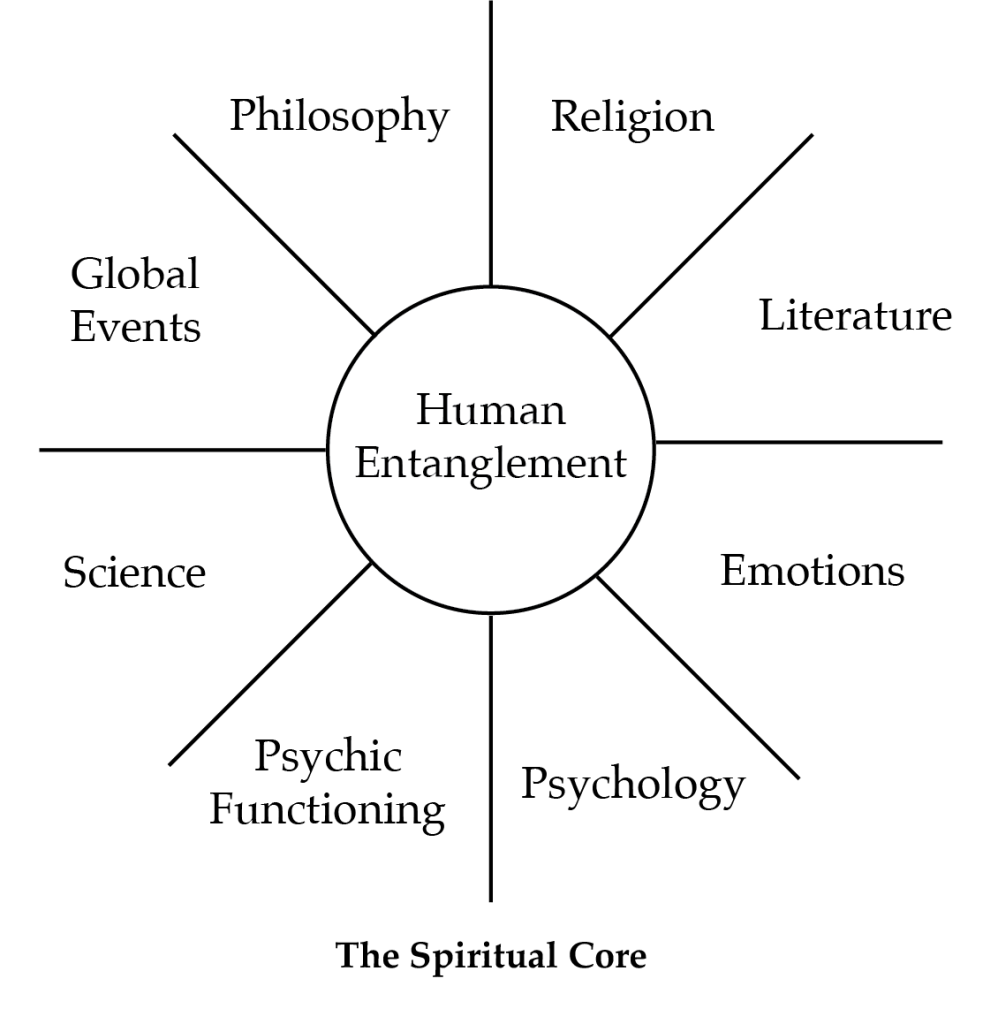
Huxley’s book, The Perennial Philosophy, is about the spiritual core. It is what the term “perennial philosophy” means. (I had to look it up.) Huxley mentions the term was first coined by Leibniz in the 1600s, but goes back well before that time. The term refers to the idea that there is a shared truth underlying all religious, philosophic and psychological doctrines. It’s not a new idea.
Huxley’s book is a thorough, and very dense, exploration of the idea.
This book is yet another look at that same concept, but with a much simpler framework, and vocabulary. That is that we can view human life with three components: an inner self (needs/heart), an outer self (wants/mind), and observable reality. Others, including Huxley, have different words, different concepts, more or less complex models, but for this book those three components, and the relationships between them, which were explored in Part I, can be used to view larger ideas of life in a different light.
A Logical Look at the Illogical
“There are only two ways to live your life. One is as though nothing is a miracle. The other is as though everything is a miracle.”
— Albert Einstein
I think there are actually three, but Einstein had already thrown out the middle, or second one, when he wrote that.
The situation is that there are times when something seemingly miraculous happens, times when reality seems to perfectly meet inner needs in an almost magical way.
However most of the time, external reality seems like a sequence of random events, having nothing to do with individual goals and aspirations. These more common times affirm the common sense view that there is no deep connection between external reality and inner self.
The question, then, is, what kind of model of life can be used to explain both the occasional, seemingly, magical connections and the more common seemingly randomness of life?
The possibilities fall into three broad categories.
1– The Universe is mechanistic, events are random, but sometimes coincidences occur that make it appear as if there are connections where, in fact, none exist. (The human brain is an excellent pattern matcher, finding patterns everywhere, even where none exist — this is how superstitions start.)
2– There is a larger force that sometimes intervenes in our lives, watching over us if you will, but mostly leaves us to our own devices in a mechanistic Universe.
3– Everything is connected to a deeper inner self, but most of the time, due to the influence of our outer self (ego/wants/mind), we fail to see the connections, making them appear random and mechanistic.
Consider the second view first. While probably the most common view, it is simply not intellectually satisfying. While it explains the data perfectly, it just doesn’t make sense that there is some force, God? the Universe? that only periodically meets our needs and other times leaves us alone.
It is for this reason that many thinking people have opted for variations on the first view. That view is logically consistent and intellectually satisfying. Those holding this view might be atheists, or might believe in a higher force that started the whole thing rolling eons ago but is not involved in our day-to-day affairs.
While intellectually satisfying, the view that there is a logical explanation for everything has the downside of somehow taking the fun out of the more magical moments in life.
What about the third view? Because it postulates a uniform mechanism that explains all situations, it is as intellectually satisfying as the first. It is also more emotionally satisfying than the first view because it recognizes that those magic moments are, in fact, magical.
These remaining two views can be summarized as:
1– It’s all mechanistic, but just seems magic sometimes.
3– It’s all magic, but just seems mechanistic sometimes.
There are two serious drawbacks to the third view, one logical and the other emotional.
The logical problem is the third view defies common cause-and-effect logic. (That’s why it’s called magic.) If my external reality meets my inner needs, and your external reality meets yours, and I’m part of your reality and you’re part of mine… well you see the problem. The third view can only be seriously considered if one is willing to question the very nature of time and cause-and-effect reasoning (as current science does).
Even more challenging than the logical problem, is the emotional problem. Just as the first view is no fun because it takes the magic out of the times when things just work out perfectly, the third view can be devastating because it implies there are deep connections at work when things all go to pieces. It means our realities reveal more about us than we might like. The third view is not for the feint-hearted.
For me, I’ve opted for the third view simply because there have been too many times, some documented in Part I, where it’s seemed magical. No one time would have convinced me, but the continuing experiences have.
This isn’t to say I always see Reflections, and, in fact, most times I don’t. But I see them so often that it makes more sense to me that Human Entanglement is real and that I’m just not always seeing it. This view has the pleasant side effect of providing more peace in my life.
For you, my reader, it’s not really necessary to actually adopt the third view. But for the sake of reading on just assume it’s true and see how so many of our concepts about life look different from that point of view.
From here it’s a journey of the mind, and a fun one. Enjoy. [author note: the following sections in the book show how the idea of Human Entanglement sheds light on various human endeavors.]