
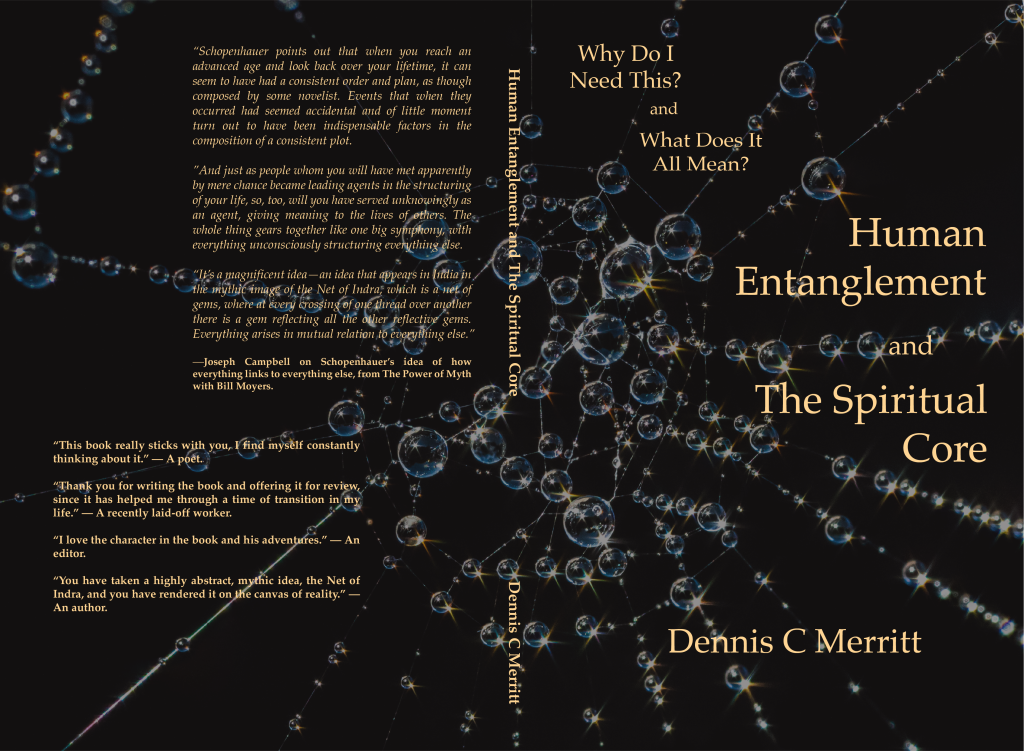
Available from the author direct, if you live in Shelburne Falls, or from Amazon* or as a free downloadable PDF:
There are many books that discuss and explore the oneness of everything, the spirituality of it all. This is another. But it is different. Instead of theorizing about religious or metaphysical concepts, it starts with real stories–about colds with my parents, getting fired from sales, getting into AI, therapists, family dramas, etc. In each of these one can see a Reflection between reality and some inner unexpressed need, different from expressed wants. It is this phenomenon I’ve called Reflection which can then be used, in the second part of the book to better understand all those abstract concepts.
As one reader said:
“You have taken a highly abstract, mythic idea, the Net of Indra, and you have rendered it on the canvas of reality.”
Samples From the Book
Reflection Hypothesis – The basic idea behind the actual stories in the first part of the book, Human Entanglement.
Colds at my Parents – The first story in the book, about colds at my parents that reflected an inner sadness.
Three Therapists – Stories illustrating the Reflections between helpers and helpees, how we’re all Entangled together, in this case with therapists who helped me during one of my divorces.
The Spiritual Core – The introduction to the second half of the book, The Spiritual Core, which looks at how the idea of Human Entanglement can shed light on various human endeavors.
Religion – How various religious concepts look in light of Human Entanglement.
Global Webs – We’re all connected.
On Amazon: Paperback or Kindle
* I’m as disturbed as many are by the incredible wealth Jeff Bezos had made from Amazon, and how Amazon dominates our shopping experiences, and all that, but am very ambivalent, because Amazon has made it possible for authors to get their works in front of people without having to go through the judgmental hoops of conventional publishers.
This is more than just theory for me as when I first wrote this book I was a published author, for my software books, and had an agent, who did his best to shop this book around.
It was the classic story of rejection after rejection, with them often noting it was a good book, but not one that fit into their distribution, or not one that they could sell. As my agent, who believed in the book, said, he could sell it if the stories were about a famous person, like Marilyn Monroe, or if I were “Dr. Dennis C Merritt, famous Jungian** psychiatrist.” But neither is the case.
Well, they were right, I haven’t really made any money from the book, and they probably wouldn’t have either, but still, the book is out there now and has touched some people and is available for those who might find it of interest.
** Jung’s ideas on Synchronicity are, of course, similar to and illustrated by many of the stories and ideas in my book, but, how’s this for a strange coincidence, there is a Dr. Dennis L Merritt (not me) who is a Jungian psychiatrist.