This issue had more about Dan Simmon’s “Hyperion Trilogy” which drew it’s inspiration from Tom Ray’s experiments in getting intelligence to evolve in what he called a digital soup.
Evolving Machine Intelligence
“Everything we know about life is based on one example of life: Life on Earth. Everything we know about intelligence is based on one example of intelligence: Human intelligence. This limited experience burdens us with preconceptions and limits our imaginations.” — Tom Ray in his critique of Kurzweil’s book “The Age of Spiritual Machines.”
One of the things I found fascinating about the Hyperion Trilogy was the concept of the “AIs,” intelligences that evolved in the information networks of the future. Not AIs built by humans to human design specifications, but rather AIs that evolved in the primordial digital soup of a vast information network.
Tom Ray’s work on evolving machine intelligence was the basis for that bit of science fiction. What is refreshingly different about Ray’s work is how he tries to escape from anthropomorphic thinking about artificial intelligence.
It is his claim that biological intelligent beings were produced by evolution, and the best way to create silicon intelligent beings is the same. To this end he developed the first Tierra program. It had a mechanism to let programs evolve, but there was no “artificial” human motivation, like searching for food, that drove the evolution. Rather, these were just programs trying to reproduce themselves, competing for CPU cycles and memory.
In other words, Ray’s work goes exactly opposite the working definition of AI for this newsletter. Rather than building a virtual machine antithetical to a computer’s nature, he was seeking to evolve intelligence totally within the realm of “data” and “processing.”
Of course, he had to write a virtual machine to do it.
His virtual machine had a machine language designed to support evolutionary change, and an original program that made replicas of itself in memory. But mutation would enter into the replicas from time to time. The result was replicating programs evolved that were much smaller and faster than the original. Also parasitic programs evolved that used code from other programs, and hostile and friendly programs.
Wow.
But his programs never got much beyond that, and he figured the problem was the limitation of a single machine. This led rise to Network Tierra, whereby the unused cycles of all the machines on the Internet could be used to house a “game preserve” where digital creatures were free to evolve.
Tom Ray’s work is an excellent example of what can happen when disciplines cross. He is not a programmer. He is a zoologist. And his interest in evolving intelligence in a digital medium was motivated to a large degree in the possibility of creating a laboratory where the mechanism of evolution could be better studied.
Based on his latest writings, it appears as if the Network Tierra has slowed due to technical difficulties. His creatures were consuming too much band width. Ray has also moved his focus to some other evolutionary software projects that more closely model organic evolution. These have yielded some very visually pleasing pictures and movies, but that’s for a later newsletter.
This was from the first newsletter. Note that the current AI represents a vastly superior way of pattern matching, down to the level of pixels in art work (which is why it requires so much computing power). It has since conquered the game of Go and
I always loved the way Hyperion referred to a historical event (in it’s fictional Universe) called “The Big Mistake” which caused humans to have to leave Earth. Spoiler alert — It was AI.
Welcome to the Premier Issue
Welcome to Dr. Dobb’s AI Expert Newsletter. Before you begin to talk about Artificial Intelligence (AI), you have to deal with the name itself. It leads to impassioned philosophical debates, like those raging right now on the AI Forum, and inspires some great science fiction. (The Hyperion Trilogy by Dan Simmons is my favorite, based on Tom Ray’s fascinating Tierra project, but that’s for a later newsletter.)
Debates on machine vs. human intelligence are fun, but this newsletter needs a working definition of AI that more realistically encompasses the wide variety of fascinating software and hardware usually classified as AI. So we’ll define it in terms of computer nature rather than human nature:
Artificial Intelligence (AI) is the art and science of making computers do interesting things that are not in their nature.
What is a computer’s nature? Well it has memory that’s good for storing data and a CPU that processes sequences of instructions. If you have a problem that requires automating data storage, procedures or both i.e. data processing, then computers are perfect. Other types of problems are trickier.
Consider Mycin, one of the earliest AI programs. The developers were posed with the problem of trying to automate medical diagnostic knowledge that was best expressed as rules.
The rules were neither data or procedures. Trying to force them as either was untenable for any significant body of knowledge. So what could they do?
The answer lies in the words of some long forgotten hardware engineer:
“Software is a kludge for getting around design flaws in the hardware.”
What the Mycin developers really needed was a new kind of computer: one that processed rules. So they created a virtual machine, they called it an inference engine, whose nature was ideal for processing knowledge expressed as diagnostic rules.
People in the AI field have been doing the same thing ever since, creating virtual machines that are programmed in non-conventional ways, and using those machines to perform previously untenable programming tasks.
Which leads to the problem with an AI newsletter. There isn’t a common language, like Java or C++ that is used for AI applications, nor are there standards like SQL for database access, or HTML for Web browsers.
Nor are these virtual machines similar. The classic ones deal with a wide variety of rule languages and reasoning algorithms, while others deal with semantic networks, neural networks, ontological knowledgebases, genetic algorithms, artificial life, robot brains, cellular automata and, of course, games.
And then, given a specific area of AI one can write about how to build the tool, or write about applications of the tool. The former is solid programmer stuff; the latter requires some knowledge of the specific tool, which is often a commercial product.
So I’m asking for your input. There is a wealth of fascinating subject matter that this newsletter can cover, and I’d like to know what your interests and experiences are. Send me e-mail. Tell me what you’re currently doing with AI and what you’d like to see covered in the AI Expert Newsletter. I want the newsletter to meet your interests.
Brains in Bahrain was the latest man-machine chess showdown of champions, pitting Kramik (a human) against Deep Fritz (a software program). Kramik won the early matches in what was called a triumph of anti-computer strategy. Deep Fritz won the later matches in what was called a triumph of anti-human strategy.
Chess playing has often been considered an ultimate test of machine intelligence because it is too complex to be mastered using straight-forward search algorithms. That is, the search space of possible moves is too great to be explored by a machine.
Early researchers worked on encoding the essence of grandmaster reasoning to improve performance. They learned, for example, that grandmasters had greater “pattern vocabularies” than weaker players. They didn’t reason faster than weaker players, but more efficiently because they were reasoning using larger chunks of knowledge.
With the speed of today’s machines, the value of the brute-force search in chess had become more important. Its ironic that in this classic test of machine intelligence, computers are playing on a par with the best humans more by exploiting the natural strengths of computers, and less by the application of human-like intelligence. Intelligent or not, today’s top chess programs are masterpieces of software engineering.
It is interesting to note that Deep Fritz is not Deep Blue, which was dismantled after defeating Kasparov in the last man-machine chess championship. Deep Blue was an amazing mix of specialized parallel processing hardware and software capable of searching 200 million moves per second. Deep Fritz is a souped up commercial product from ChessBase running on stock hardware capable of only 3 million moves per second. They claim it’s smarter though.
As for humans, with their feeble CPUs, they still provide stiff competition for millions-of-moves-per-second machines. It all appears to revolve around superior recognition and processing of patterns. And when you take a heavily pattern-oriented game like go, well computers aren’t even close, yet.
1738 Artificial Duck
Dr. Jessica Risken of Standord University has done a study of a mechanical duck built in 1738 that created the same interest and excitement as current experiments in artificial life. The parallels between their desire to use mechanized models to understand real life, and ours, are fascinating.
Among other things, the duck was realistic in that it ate and pooped. But if you looked inside, it sort of cheated. Food went in, and time passed, and poop came out, but the input food was still there, and the poop had been pre-loaded. So the duck didn’t really digest, it just looked like it did.
That is not dissimilar from the chess programs that look like they understand the patterns on the board, but instead are processing millions of individual moves.
But also like the chess programs, the duck was an amazing bit of engineering and probably a lot of fun to build.
It’s deep, and it’s light, and simply a lot of fun to read.
Eve’s Eden is collection of stories from Soéva Sophia’s life, from growing up in 1960s Berkeley California, with all the energy of that time, through living in the mystical Mexican village of Amatlán de Quetzalcóatl, to finding, and losing, love in the community built around Salmon Falls, a bountiful fishing site once shared peacefully by the tribes of the area which is now Shelburne Falls, Massachusetts.
The stories are told with a lightness, whether her at five communicating and liberating a manta ray trapped on a pier, or seeing a magical wind become part of, and destroy an opera in Mexico, or being in love with someone who endured, with good humor, trials like Job’s.
The stories are organized and introduced by five goddesses from different traditions, from Eve, of Garden fame, looking over the young Soéva fending for herself, to Aphrodite making sense of love. The goddess’ myths shape the stories as the stories illustrate the myths.
What was most enjoyable about the book, for me, and difficult to explain, is the style in which the stories, all true, are told. There is a lightness to them and a wandering back and forth between reality and an almost dream like view as they appeared to Eve. She talks of her dyslexia and how it shapes her view of the world, how things don’t quite look to her like they might to others. This, then, invites us to see things a bit differently as well, to see reality, and, then, glimpse at the same time, the mystical threads holding it and us all together.
Start with Part I, Eve & Joyous Beingness and the story You Cannot Tame a Zebra and end with Part V, Her Fountain of Love and the story Dancing as Aphrodite. In between, well, it’s deep, and it’s light, and simply a lot of fun to read.
This letter was published in the Greenfield Recorder, a wonderful forum for community opinions. It’s not meant to endorse any actions on either side of the current Middle East situation, but merely understand at least one Arab’s point of view.
(Note — Salmon Falls is at the center of Shelburne Falls and was a place for Mohawk and Penobscott Native Americans to hunt salmon in peace.)
—–
I read that many think anti-semitism is behind a lot of the Palestinian aggression. I believe this is a mistake, caused by our own experience with anti-semitism in this country. It is a pervasive, nasty undercurrent in a lot of our society. A real estate agent once told me a good reason to buy in a certain Boston suburb was “there is no temple, if you know what I mean.” Another time, in a different suburb, after having bought a house from a Jewish family, we were told by the neighbors how glad they were to see Christmas lights again.
Whether, in fact, one is themself an anti-semitic, or offended by anti-semitism, it is easy to look at the Arabs attacking Israel and nod in understanding.
It probably goes to our religious heritage, with a strong European Christian component bearing prejudice against those of a more middle-Eastern Jewish heritage. In fact, there is European and US prejudice against many middle Eastern cultures. The Holocaust also wiped out most of the Roma in Europe, and today, anger at Muslims is high in both Europe and our country.
Maybe Jews and Muslims have more in common, with their middle Eastern roots, than Jews and Euro-centric Christians. Maybe something else is going on there that we don’t relate to.
I was talking with an Arab friend once about the Middle East, and curious about his views on Jews and Israel. It turns out he had a profound respect for both Jews and Judaism. He expressed a deep understanding of their religious beliefs and the life style they live based on those beliefs. This was a respect that I had never heard in this country, even from my Jewish friends.
I’m thinking he saw the similarities between those of each faith who live by an understanding of the way God/Allah works in one’s life. Both Judaism and Islam are peaceful religions, emphasizing an individual’s relationship with their God.
But my Arab friend continued, “no, I have no issue with Jews, it’s Zionism I hate.”
The problem, for him, was that land was granted to Jews for a Jewish state, and that Arabs were displaced from that land to make it possible.
I think we can understand this sort of feeling with issues in our own country. Take affirmative action. These programs were put in effect to help correct our history of racial injustice, to give Blacks better access to, say, college. Now, take a white family trying to get their kid in college. They might be upset that they are the ones being asked to make a sacrifice, in a lowered chance for their kid, to correct racial injustice. It doesn’t mean that they’re racist (although they might be), it means they’re mad that some government decision said that they’re ones who should have to sacrifice to fix racial injustice.
The same can be seen with the ACA mandate. People were being forced to buy insurance that they didn’t want to buy, in order for the insurance companies to make enough money to provide cheaper insurance for those less fortunate. The issue, again, is that they didn’t see why they should be the ones to have pay the price of fixing a societal injustice.
For many of us in this country, knowing of the history of persecution of the Jews, we think, yes, fantastic, there should be a Jewish homeland. The problem is the Arabs who lost their land to make that happen are upset that they’re the ones being asked to sacrifice to remedy years of Jewish persecution.
I know many non-native Americans are bothered by how we treated the Native Americans, but I can’t say as I know of anyone who has offered to give their home, their small bit of land, back to a Native American family. I don’t think those of us in Shelburne Falls would be particularly happy if the government, a thousand miles away, decided we had to move out in order to give Salmon Falls and our village back to descendants of the Mohawks and Penobscotts.
The Economist columnist, Johnson, recently wrote about the advantages of pencil and paper over computers for writing and note taking. I totally agreed, and wrote this letter to him/her.
Dear Johnson,
There are four sections I read without fail in the Economist. The Obituary, the bottom right letter to the editor, Lexington, and your column, Johnson.
You recently wrote about the advantages of pencil and paper over a computer. I’m writing to tell you how much I agree, and share some of my experiences.
First, let me say that, I might be reading too much into this, the column you hand wrote on the subject was—I don’t want to say better, the columns are always excellent—but it had a smoother feel to it. It flowed and the words, the turns of phrase, had a gentler more organic? touch.
Crosswords
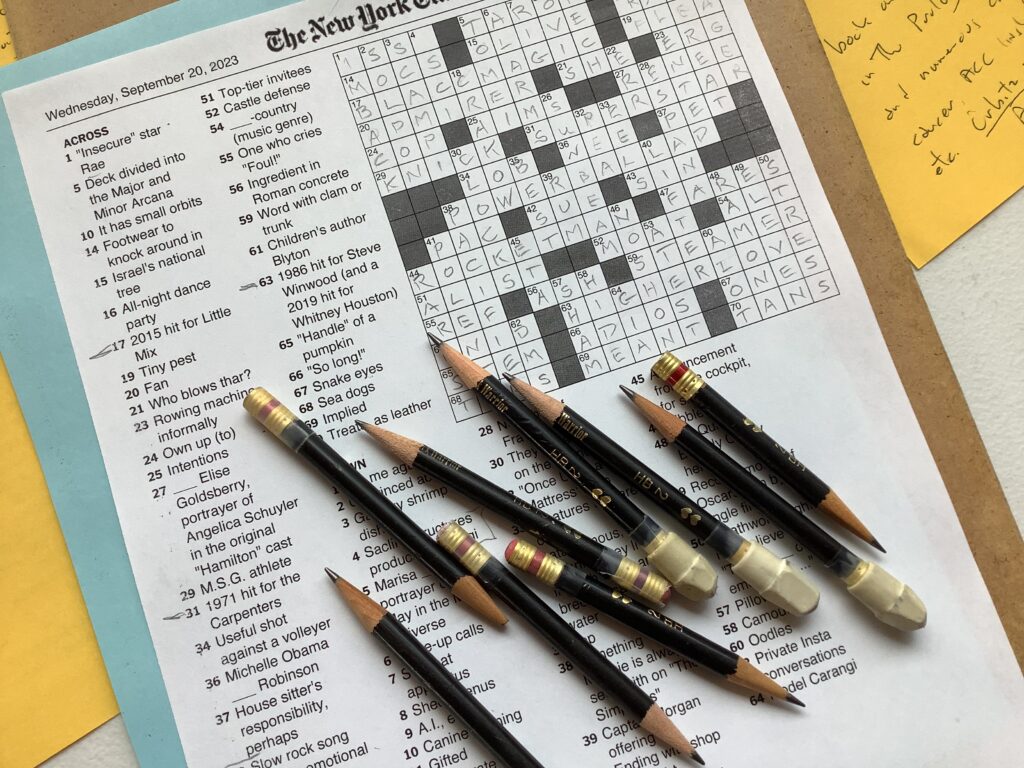
We (my wife and I) do the New York Times crosswords, but we don’t do them online like many do. We find it much more satisfying to fill in the boxes with a pencil. Now, here is something you might want to note. Pencils are very cheaply made these days, and it’s worth investing in good pencils. I highly recommend Mirado Black Warrior #2 pencils and an electric pencil sharpener. I also put artist quality erasers on the ends to make the writing of answers, and the subsequent erasing of the wrong ones, a pure joy.
For some perverse reason, I save the pencils when they get too short to use. I enclose a picture of our retired pencils and a puzzle.
Accounting
My father was an accountant and one of the things passed on to me on his passing, along with old check stubs and the like, was accounting paper. When (my wife and I) started our own small business, I did all the accounting using a pointy pencil and my dad’s accounting paper. Eventually she said we needed to move to a computerized product, which we did, but it wasn’t the same.
I found I had a much better feel of the business when hand writing in the expenses and the sales, adding up the columns, creating the balance sheets, etc. Something felt disconnected when we had the computer generate those numbers.
Software Development
Software was, back in the day, designed on paper, with boxes and lines and arrows and whatever, and multiple sheets with the different sections spread out across the desk. I was working for a software company that was a pioneer in the development of computerized software design tools. I remember the head of development talking about the work and holding up a pad of paper and a pencil, saying that was the competition.
Using the computer for design work, he pointed out, would be like designing software with blinders on. It’s as if you had a mask held over the desk that would only let you see part of one piece of paper at a time.
Writing
I do some writing as well, and use both paper and pencil and software. Here is a paragraph from the acknowledgements I wrote in my book, “Jazz Chords for Baritone Ukulele”:
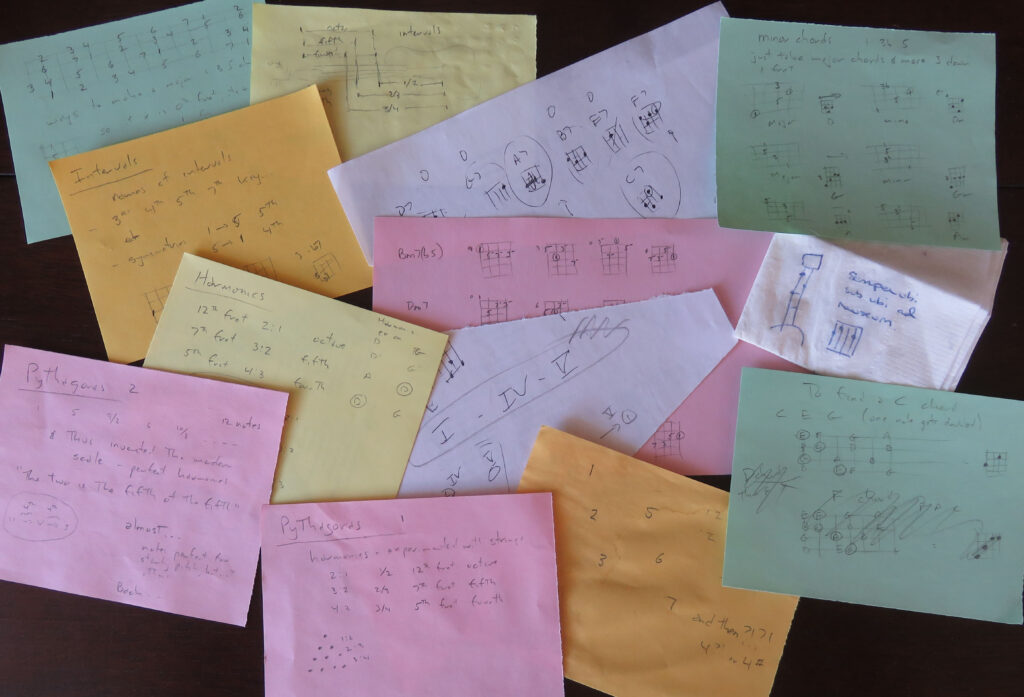
“I’d like to acknowledge two excellent software tools I used. Sketch for making it easy to create all the diagrams in the book, and Scrivener for providing beginning-to-end tools for organizing, editing and compiling the manuscript. (However, for working out early ideas and organization, no software tool can compete with 1/4 sized sheets of colored paper and Mirado Black Warrior pencils.)”
My cousin, Russell Merritt, recently passed away. I was asked to talk at his memorial for a family perspective. The other nine speakers were all people from his various walks of life presenting a wonderful overview of the lives he touched. Here are my comments.
We had a small family. I was an only child as was my mother. My dad had a brother, my Uncle Dan who, with Aunt Joyce, had my cousins Russell and Carole. They were a little older than me, and Carole always remembers them enjoying me coming to visit as she and Russell would argue over who would get to play with me. I don’t remember that too much, but I do remember enjoying seeing how they interacted, the connection between them. The laughter, the in jokes, the twinkle in their eyes.
Carole’s Stories
Carole said she thought growing up with Russell was just how siblings were. She had no idea how special it was, with Russell coming up with all sorts of ideas for adventures and games for them to play. The ideas weren’t simple. Like the time Russell thought they should play disc jockey. Well you couldn’t just do that. First the the room had to be cleaned and set up like a studio, then the playlists had to be worked out, and the commercials, and everything just so for putting on a disc jockey show.
They had secrets as kids, hiding from their mother. Like one hide out was behind the “whistling” door, which turns out to have been a cabinet with a squeaky door that little kids could crawl behind and read their comic books with flashlights. Carole suspects their mother knew…
I wonder how much of Russell’s development was fueled by his willing partner, Carole, in those early childhood adventures.
Carole was not the student Russell was and she always marveled at how different they were. I remember when Russell was finely getting ready to start teaching and Carole said, “Fail a few for me Russ” and Russell said he would.
Sherlock Holmes & Wilbur
Of course Russell is remembered for his love of all things Sherlockian. He’d explained to me that that was started by our grandfather, Wilbur. Apparently something was lost one day, and Wilbur told Russell he’d help him solve the mystery of the missing item, but, he said, it will require careful logical thought. We need to think like Sherlock Holmes. Russell was hooked.
It probably wasn’t much after that that we started hearing stories of Russell’s exploits and I remember he had built this detailed scale model of 221b Baker St.
Puzzle
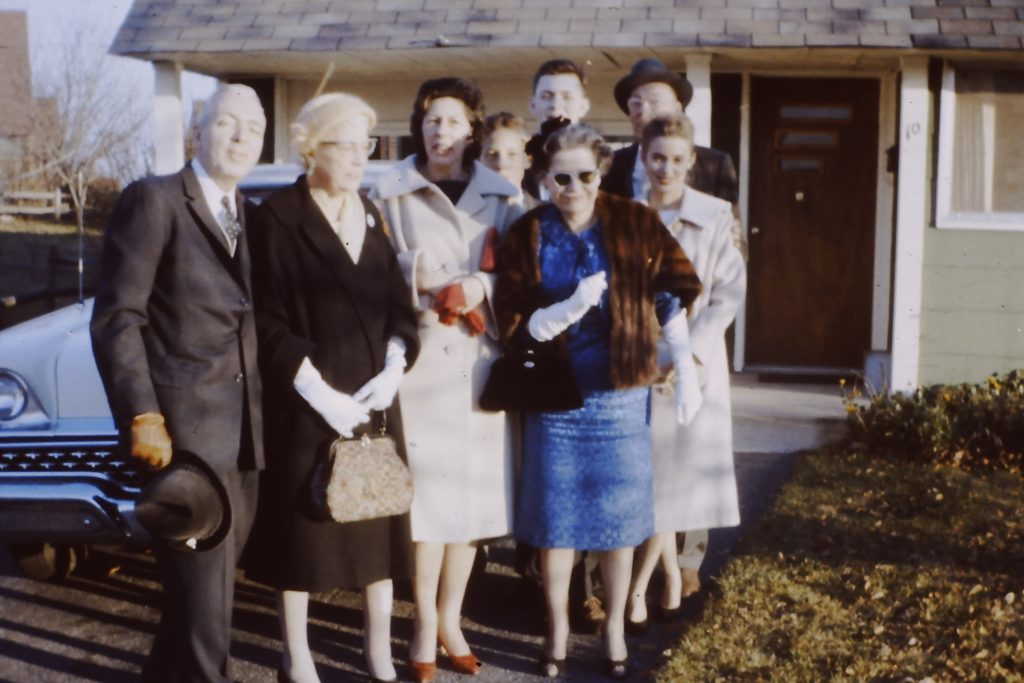
Here’s a family puzzle requiring Sherlockian analysis. Wilbur and Mary were married and were grandpa and grandma to Russell, Carole and me. Mary was our mutual biological grandmother. Wilbur, however, was not Russell’s or Carole’s biological grandfather, but he was mine. There was nothing illegitimate, everyone rightfully married, or remarried, so how could that be? Contact me if you think you know the answer, or want to know. It’s classic Holmes, “When you have eliminated the impossible, whatever remains, however improbable, must be the truth.”
A clue… From left to right: my Uncle Dan, Grandma Mary, my mom (Aunt Peg), me, Russell, my Aunt Joyce, Grandpa Wilbur, Carole. Photo by my father (Uncle Ralph).
MWA in New York
One of Russell’s story of growing up involved him getting involved with the Mystery Writers of America chapter in New York City. It was easy to take a train from where they lived in N.J. so Russell found them and hooked up with them. They made a deal with him. If he cut school and came into the city and spent his morning working on his writing, then they would help him make letters of excuse for missing school, and he could spend the afternoon exploring the city.
It was a great deal, but the problem was, these being mystery writers, all the excuses involved a death in the family.
This went on for awhile, but eventually the school got suspicious. What I loved was Russell telling me the story, laughing as he told it. “My mother was furious, but not at what I’d done. What she was really mad at was that I had only killed off relatives on her side of the family. I didn’t kill you, or Aunt Peg, or Uncle Ralph…”
Christmas Goose
Growing up there was one Christmas where Russell made a show of dinner. He was in high school and got it in his head he wanted to make a full Dickens Christmas with a roast goose and all the trimmings. Who does something like that in high school?
That Christmas Carole and I got more playing time together and I don’t think either of us at the time appreciated or understood what an amazing thing he was doing. The grownups were all impressed though, and I am now.
Wedding
My biggest regret was when Russell and Karen got married. My dad went, but he recommended I pass as weddings were boring. I guess he didn’t know Russell that well… I suspect many here were part of that spectacle. What a show it must have been.
Reunions
Time passed and our parents were dying. We hadn’t seen each other for years, but there we were at the funeral of some parent, just standing there, and someone said something funny and we all just started to laugh and laugh until we cried. We said we need to get together more often cause we’re running out of parents.
Then it was Aunt Martha, don’t ask, who died and second? cousin Al and his wife Linda and we started having the family reunions. I put a question mark there because our family history those few generations back was pretty confusing. Like Aunt Martha was an aunt of our fathers except not really much older than them.
Who steered our way through that history? Russell. He had all the players and their comings and going and could explain why we were all related to the first post mistress of the Panama Canal Zone, and at each reunion we would go through it again and laugh at our confusion and write it all down so next time…
One character in the history was our ne’er-do-well grandfather, Ralph Merritt senior, who apparently had left our dads when they were around five. (That’s why Grandma Mary remarried.) Our dads would never talk about him, so we knew next to nothing. But Russell’s research dug out something. He found an obituary in a New York paper describing a car crash on the highways around New York.
There was a core at the reunions, me, Russell, Karen, Carole, Butch, Al and Linda, but then there were other family members always there as well, my son and his family, my daughter, Carole’s son and granddaughter Ali and for Mike and myself, our wives.
I always enjoyed hearing Russell at the reunions, just the wide range of stuff he was interested in, but for me, one of the biggest highlights was seeing him interact with Carole, laughing at the same jokes, doing the same routines they had as kids — “zip it”— and all with that same twinkle in their eyes I remembered from those years past.
And on a similar note, to see the love he shared with Karen, well it was just a pleasure to be around.
Grandboys
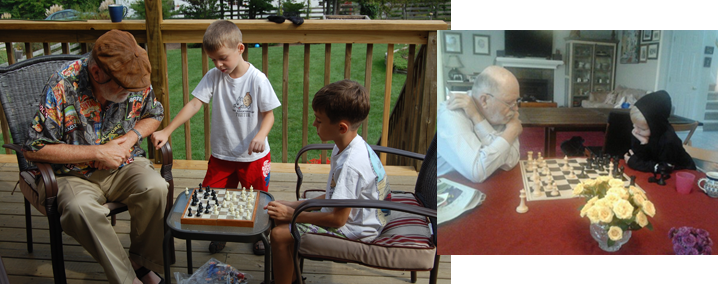
My grand boys were at the reunions as well, Juan, Diego and Miguel. Russell always enjoyed interacting with them, and I’ve since heard they were a highlight of the reunions for him. He shared a love of chess with them.
Film too, maybe it’s in the genes somewhere? but the boys started making movies a while back. The last communication I had with Russell was when I told him Diego was in Italy and taking Italian film classes. Russell sent back an email with all sorts of films that Diego might enjoy watching. Not just a list of films, but films in categories, historically important, good, and maybe of more interest to a younger generation.
Sigh, it would have been great to see that connection grow…
Let’s think about our trial system, and how it might apply to our democracy itself.
In a criminal trial, there is the “prosecution,” made up of advocates for proving the defendant is guilty, and the “defense,” made up of advocates for proving the defendant is not guilty. These advocates argue their sides of the case, presenting evidence as available to support their stances.
It then goes to the jury, twelve unbiased individuals tasked with weighing the evidence and seeking the best, most fair outcome. The idea is the jury can balance and weigh the arguments pro and con, debate those arguments, and try to reach a consensus on guilty or not, based on the evidence.
Imagine if you will though, that instead of twelve random individuals, each side got to place six advocates. So in the jury room there are six jurors aligned with the prosecution and six with the defense. How would that go? A hung jury.
What if then only a simply majority, rather than a unanimous decision, could decide the case? Well with our six and six, still a hung jury. What’s more, because the jurors are all advocates, they would not put much weight on the evidence provided in the trial.
What if the prosecution had seven members and the other side five? We’d get guilty verdicts all the time. And if the defense had seven? Nobody would ever be found guilty.
Imagine civil trials where each side could “buy” jurors. This is why jury tampering is such a serious crime.
So no, we wouldn’t want to have juries filled with advocates for one side or the other. That would be no way to get a fair and reasoned verdict for any particular case.
Do you see where I’m going with this? The laws of our land are made in Congress. Who makes up Congress? Advocates. Advocates with allegiances to one or the other of our two political parties. This has no better chance of working well than trying to get a fair verdict from jury of advocates.
Why didn’t the founders think of this? They knew you needed jurors for fair trials, but didn’t think elected congress people would be a problem?
Well they hadn’t counted on the rise of political parties. And money being spent to get advocates for some position elected.
Aaron Burr, in the earliest days of our democracy, saw the gain to be had by actively electioneering to get a position he could then use for his personal gain. Shortly thereafter we got the first political parties organized to get advocates for (does this sound familiar) larger or smaller federal government.
Why are such vast sums of money being spent on political campaigns? Because the results are worth it..
Is there a better way? Can this be fixed at this late stage of the game?
Yes. Replacing Congress with a random selection of unelected individuals would be great, but that’s not practical. What is practical is something called a Citizen’s Assembly (CA). Like a jury, the individuals in a CA are selected to reach a decision on a specific issue. They are selected at random, just like a jury. After reaching a decision on an issue, the CA is disbanded.
Congress, or any legislature at any level of our society, could convene a CA to decide on, say, Alaskan oil drilling, or whether to fund a new fire station in town. The advocates would make presentations, experts would be brought in, evidence would be gathered, and the CA would deliberate and make a recommendation. The legislative body could then make the recommendation law.
Given what I’d read about TikTok, the Chinese app that’s captured our country, that it’s silly videos of teenagers lip-syncing and dancing, I didn’t have much interest in it. But I had created some instructional videos on YouTube about chord scales for jazz guitar that I was looking to get wider exposure for, so I thought I’d try TikTok.
How my videos did is one story. Relatively quickly they all had around 400 views. Here is a key point. Those weren’t 400 people who decided to watch, but rather 400 times that the TikTok algorithm decided to put one of my videos in someone’s queue, based on what it thought they might like.
Why 400? And why did it stop there? Well it appears what the algorithm does is pick, say, 10,000 people and use them as a trial group for a new video. Then it watches how they react. It’s not looking for “likes” but rather how long someone looks before swiping to the next video. Clearly, based on those responses, TikTok decided not to expand my audience. Had there been a good response, then it would have increased the viewership.
This is how some videos get a million views very quickly. But notice, those million views are not a million people choosing to watch it, but a million people TikTok decided to send it to, watching, learning, studying how they react.
But that’s not what I want to talk about. Of course I decided to see how it works for me, and started watching. Sure enough, silly videos of teenage lip syncers. I swiped passed them. Then some other stuff, things I had no interest in, but, in very short order, TikTok’s algorithm said, well if you don’t like those, how would you like to see Bob Dylan at the 1963 Newport Folk Festival? When he first went electric.
I doubt anyone much younger than me, 76, really has any clue as to how big that was. Bob Dylan was the star of the folk music rebellion against top 40 hits and glitz, the idol of all us hippies to be. And he trades out his acoustic guitar for an electric?! At the biggest folk festival in the country…
Oh yeah, I want to see that. (I’d never seen footage of it before.)
OK, so I’ll scroll some more. OMG, look at the size of the wave that guy’s surfing! And in very short order TikTok figured out that I like surfing videos, clever chess traps, how to play guitar licks, ladies falling out of their tops (no porn, they never actually fall out), the latest news, stories about how dumb Trump is, really cool poker show downs (like when two players each had pocket aces, but then four hearts showed up in the flop so the guy with the ace of hearts won.) And swing dancing, tango dancing, peaceful scenes with music I like (it never plays anything with rap or techno in it for me), and the news from Iran.
Iran. Lots of current video of this women led revolution against the theocracy. They’re using social media to appeal to us to share the names of those arrested, to make it more awkward for the government to execute them. Heavy, heavy stuff.
All of this is mixed up and presented in a way to just keep you interested in “one more.” I was about done the other day, gonna put it away, and it says, before you go you want to see Secretariat winning the Kentucky Derby? OK, I’ll watch that.
The thing is, I believe the TikTok algorithm knows me better than I know myself. And I’m not a teenager scrolling at my desk in school.
I understand how TikTok is now getting more views than FB or YouTube or anything else. I understand how it’s totally addictive. The problem is, it’s not just wasting my time. I was up-to-date on all the election news through TikTok faster than through my Washington Post or New York Times online accounts. And learned some great chess tricks to use against my grandson, and how to play some classic rock guitar licks. And interesting science facts, like explanations of quantum entanglement. Neil DeGrasse Tyson constantly shows up in my feed. Is it bad the kids are exposed to him? But are they? Or does he just show up to people like me?
I understand how scary this is to those in charge. My TikTok feed totally reinforces my views that the Republicans are bad, Trump is a threat, and the Iranian revolution is a good thing. How hard would it be for it to start to influence me in some other directions? Would they want to? I can’t say as I’ve seen anything about politics in China.