Citizens’ Assemblies

A recent letter to the editor outlined what the author thought would be a reasonable approach to immigration reform. It got me to thinking about what a friend of mine had explained to me about Citizens’ Assemblies, a form of sortition.

What’s sortition?  It turns out the Athenian Greek democracy did not elect representatives.  Instead they were chosen at random from the population.  That’s sortition.

For some, the very fact that we elect our representatives is at the core of the problems with our government today.  They argue that if congress were made up of randomly selected, demographically representative individuals then a lot more would get done, and get done better.

Why?  Because the representatives would focus on the issues, not the visibility of the issue and how it affects their fundraising and chances for re-election.

That’s clearly not going to happen to our Congress any time soon, but there is a variation on the idea that is happening in places and could happen on a national level.  It’s called Citizens’ Assemblies.

A Citizens’ Assembly is a group of randomly selected, demographically representative individuals brought together to address one particular issue, hopefully to make law, but at least to make recommendations.  These could be relatively large groups.  They would take input from various stake holders and experts.  After making their decision, they would disband.

An example of a Citizens’ Assembly is a jury.  Random people together to solve one particular issue.  It works reasonably well, even for contentious issues.  Imagine if Derek Chauvin’s fate was to be decided by Congress, rather than a jury.  The vote would be split down Republican/Democrat lines with no-one particularly caring about the particular facts of the case, like the medical testimony on what actually caused George Floyd’s death.  All that would matter to the politicians is how their base, their colleagues, and their party perceives their vote.

They can be used at any level of government.  Imagine a town wanting to come up with a sign ordinance governing what sorts of signs stores can put up, balancing the town’s esthetics and the need for local merchants to advertise.  A great problem to form a Citizens’ Assembly to solve.

On a national level, take immigration.  Imagine that a number of individuals, such as the letter writer mentioned above, were gathered together and asked to come up with an immigration policy that made sense.  Not anyone looking to get re-elected, but people from all walks of life getting together to discuss, analyze, think about a plan that might work for the country.

They would listen to current experts, to immigrants, to employers of immigrants, to the Dreamers, to those who’s jobs are threatened, to those unhappy with changing neighborhood demographics, medical experts on disease, law enforcement, etc. etc.

It wouldn’t take that long for such a group to settle on a reasonable path for our country.  It could then become law, and, since it was decided by a Citizens’ Assembly, the politicians could wash their hands of it.

Maybe every 5 or 10 years the issue would be revisited in a similar way?

My friend points out that politicians don’t actually want to solve these sorts of contentious issues.  Both sides need the issues to fire up their bases.  Immigration has been used as political fodder since, well, since forever.  Build the Wall!  Children in Cages!  Vote for us!  That’s how each side gets the voters out.

Abortion.  A Citizen’s Assembly could study and come up with a path that best reflected the conflicting opinions of the country.  And when they did, well there goes another get out the vote slogan, no more Pro-Life!, Pro-Choice! being used to get votes.

Health Care.

Gun Control.

Environment.

And so on for the issues of the day, leaving the politicians to do the more mundane work of running our government.  And getting elected based on how well they do their job, and making more visible how they do it and what’s really going on when they’re not actually doing anything about the issues they campaigned on.

Cancun Teeth

My dentist looked in horror at my latest x-rays.  Decay all over my mouth, most worrisome being large areas below the gums.

This was all relatively new.  I’d already lost two molars because of it, but now it looked like there was additional extensive damage.

I was getting implants for the two missing teeth, but since they were $5,000 each I just got the more inner one (30, I now know tooth numbers) and decided to live without the last one (31).

The new x-rays lead to a visit with one, I’m told, of the best overall dentists in the Amherst area.  He took more x-rays, admired the gold work I’d had done already, and told me to come back and he would have a plan.

The plan was for a complete rebuild of my mouth.  Based on what I’d seen as well, this seemed like what was necessary.  I could have done dentures, but if they could save my teeth…  I had some savings, but not a lot, and the house needs painting.

I went in to learn the plan.  The dentist showed me and I immediately saw the bottom line.  $40,000!  I knew it would be expensive, but that was more than I expected.  Then I noticed the top of the page.  That was for the uppers.

Next page, lowers.  $30,000.

$70,000?!?!  And that didn’t include the last molars (31, 18, 2 and 15) But I’d love to save my teeth…

dental_x-rays.jpg

My Spanish daughter-in-law said dental work was much cheaper in Madrid, so I started to look into it.  Then a FB acquaintance said he’d gotten a lot of work done in Cancun, and it was excellent.

So I contacted the place he’d recommended.  They looked at the plan.

$13,000.  And if I wanted the back molars rebuilt as well, another $2,000.

So I bought a ticket to Cancun.  Upgraded my flight to comfortable seats, bags included, got a nice Air B&B and here I am.

I had a consultation yesterday, and began to understand the economy a bit better.  The dental office was nowhere near as opulent as the one in Amherst, but the dental equipment…  Easiest x-rays I’ve ever had taken, plus photos that I’ve never had taken, and software on screens that gave the dentists views and options I’d never seen before.

Two dentists, a surgical guy and a crown guy went over the pictures, long conversations where the only word I understood was “corona.”  They came to similar conclusions as the Amherst dentist, but explained it all using the computer display.

There were some differences, they said I’d have to lose a couple of more teeth than I thought, and showed me exactly why, and what their plan was to deal with those gaps.  Another implant, a temporary bridge covering the extractions giving them time to settle, and another visit in six months to finish that work.  (The Amherst dentist was proposing supporting a bridge on a tooth that was probably beyond saving.) All still for around $16,000.

Tomorrow it starts.  Four long days, 6-8 hours of dental work, Wednesday, Thursday, Friday, Saturday. Then again on Monday if necessary to readjust, fix, etc..  A couple of days of vacation and time for me to see if anything in my new bite needs changing.  (The scheduling and billing software was as amazing as the dental diagnostic software.  The manager clicked on icons of teeth taking the dentist’s plan very quickly into a schedule of the work to be done and the billing.) And then back home.

I feel like a customer here, dealing with an organization that is proud of the service and value it provides.  Cancun Dental Specialists.  (I did feel more like a mark in Amherst, or maybe to be fair, someone who they determined might not be willing to pay the cost of American dental work and therefor not worth spending too much time with.)

How did this happen you might ask.  Well I’ve had the same dental routine for thirty years, since I got the gold work, and had some cavities and work done, but this last year’s damage was extraordinary.

I think it had a lot to do with Rolaids.  I would brush my teeth at night, go to bed, not be able to sleep because of indigestion, and then chew a Rolaids or two.  Sugar tablets in my teeth over night.

It might also be due to dry-mouth, which can destroy teeth in around three months I’ve read.  (I’ve done a lot of Googling.). The Rolaids and indigestion are related to dry mouth as well.

And old age, my gums are receding and a lot of the expensive damage is at or below the gum line.

Funny thing, upon learning all this I stopped taking the Rolaids.  And my indigestion greatly improved.  Just a little an hour or so after I eat, but none other than that and none at night.  I don’t eat much late, but I didn’t before either.

It’s as if the Rolaids were destroying stomach acid causing more to be created which, somehow could it be, was related to dry mouth.

I’ve now got more saliva than I recall having in recent years.

The Cancun dentists are also going to do a “deep clean” because they sensed the food that had gotten between the gums and the teeth.  A deep clean is one of the recommended procedures for dealing with gum disease.

I’m for sure going to have a new personal dental routine, as even after all this work, decay can still erode the underlying teeth if it continues to penetrate beneath the gums.

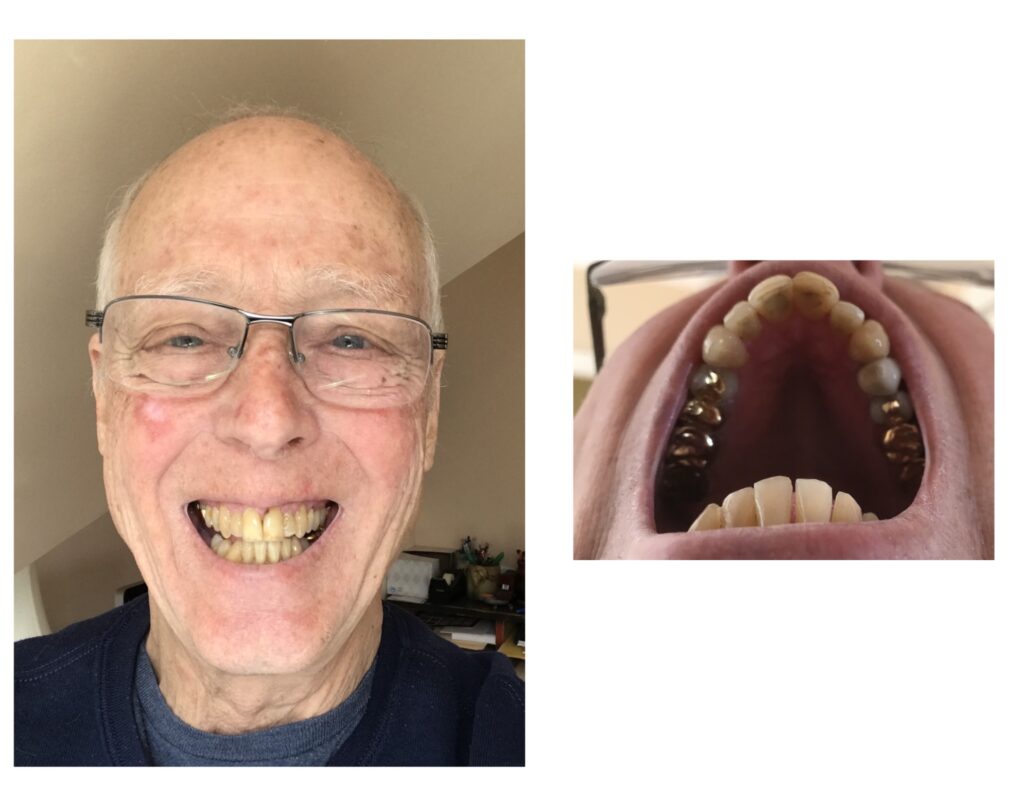
teeth_before.jpg

Those are the before pictures.  You can see the decay at the gum line of my upper front tooth.  That’s just appeared in the last month or so.  There were two similar spots on the lower front teeth as well, which were filled by my local dentist, before he sent me to the uber-dentist in Amherst.

The gold work was done thirty years ago by a dentist who it turns out was famous and known by both the Amherst and Cancun dentists.

Condiments

Opinions on the optimal mixing of condiments.

Ham Sandwich

When making a ham and Swiss and tomato sandwich with mayonnaise and mustard, it’s nice to arrange the ingredients in such a way as to maximize tasting pleasure when they mingle in the mouth.

Clearly the ham should be in one layer, the tomato in another, and the cheese in between separating the two.  The mayonnaise and mustard should be separated as well, with the mayonnaise on the slice of bread touching the tomato.

The mustard, however, should not be spread on the other slice of bread.  Instead it should be spread directly on the ham, preferably in between two ham slices so that it does not touch the bread.

Why?  If the mustard is spread on the bread, its taste gets absorbed in the bread and when the sandwich is bitten into, the mouth experiences mustardy flavored bread in the vicinity of the other ingredients.

But if the mustard is shielded from the bread, then the mouth gets to experience the bite of the mustard directly with the ham in some very exciting mouthfuls.

The same is true of a hotdog.  Spread the mustard directly on the hotdog and it’s exciting to eat.  Put the mustard on the bun first and it becomes a boring mush.

Oatmeal

You’ve got a steaming hot bowl of oatmeal.  It’s ready for the butter, brown sugar, raisins and milk.  How best to add them to maximize the enjoyment of each bite?

If you mix the brown sugar and butter thoroughly in the oatmeal, and then add the milk, all the excitement of those ingredients is lost, as they just offer a blended sort of taste, and you might find yourself wanting to add more and more sugar.

There are other options.  One is to very slightly mix the ingredients.  Then each bite will be different.  Some will have just oatmeal, and others a blast of sugar.  Sort of like when eating a layer cake, some bites are pure cake and others have a ton of icing.  Fun!

The other option is to pour the milk on top of the sugar and butter before it’s mixed in and let it sit.  Now when you mix it the oatmeal tastes like it’s in flavored milk, also a fun sensation.

I’m not sure which I prefer.

As to the raisins, well they keep pretty much to themselves but I like to have enough so that I can get one in every bite.

The last ingredient is salt.  You need some salt in the oatmeal, but unlike the sugar, you don’t want to get a bite with a spike of salt in it.  So the salt should go in before it’s cooked so it gets totally blended in and is barely noticeable.

Salt and Eggs

Unlike in the oatmeal, it’s fun to get a nice taste of salt on scrambled eggs.  For this reason it’s better to hold back on the salt while cooking, leaving some room for the tastebuds to encounter fresh salt sprinkled on the eggs while eating.

Somebody was famous for saying he would make hiring decisions based on whether someone tasted their food before salting it.  I’d say I wouldn’t want to work for someone who didn’t understand different people’s preferences, and that some like to encounter a fresh salt taste in their bites rather than a boring blended saltiness throughout the food.

Landscapes

Next I tried landscapes. We have a great view out our dining room window, across the Deerfield River with a hill across the way. So here it is.

I really struggled with how to make the trees on the hillside, there’s a lot of them, and they all sort of blur at one point but are distinct at another.

Anyway, no matter, I’m really proud of the duck in the river with his orange bill.

Next was the view across a relative’s back yard.

A grey day in the Adirondacks, and again, wrestling with what to do with blurred forest in the background. Really liked how the blue barrels came out and the bushes on the left.

Then I was taken with a photo in our newspaper. I don’t think I enjoy working from a photo as much as from real life, but still it was fun. And the same problem with the background trees.

This was a great exercise in layers though. Had at least ten, starting with a sketch and then the stuff both near and far.

Most recently I was taken with an old photo that was posted in a group that talks about our small town, Shelburne Falls, MA. It used to have an iron bridge for cars and a trolly bridge close to each other, crossing the Deerfield River. (Same one with the duck above.)

The trolly ended and the bridge was going to be destroyed but some people decided to turn it into a garden and now it’s The Bridge of Flowers and draws people from all over. That’s why it was so much fun to see this photo of when it was a trolly bridge.

It was black and white, so first I did a black and white.

And then I colorized it.

Procreate First Steps

I just bought a new iPad and Apple Pencil to mess around with. Then got Procreate which seems to be the best software for drawing. Here’s my beginnings.

First, I tried to draw what was in front of me:

As I mentioned in another post, it’s all about the journey. I had fun doing this.

From there I went to the wood stove, and made three attempts, fascinated with the fact that there is a special brush for painting flames. (We have two steam dragons on the stove.)

With my mother’s words in my head, an oil painter in her day, that drawing glass is hard, I went for the Manhattan (my mother’s drink of choice) in front of me.

Thus my first few days.

The Journey

I’ve just started playing with an iPad and Apple Pencil, drawing stuff using the program Procreate. I signed up for a FaceBook group of Procreate beginners.

There appears to be a philosophical thread, where someone will have gone to great pains to create a picture that looks photographic in its detail and ask for comments, and others will comment that what’s the point if it looks like a photograph. It should have some of the artist’s own soul in it.

Based on my own beginning experience, that view point is based on a misconception of what a picture is all about. It’s the process of making the picture that’s fun.

It solving all the little puzzles of how to use the tools to render this part of the image and that. These pictures take literally hours of work. It’s not about the finished picture, it’s about the enjoyment the artist had working on the picture.

I’m thinking it’s always been that way. The first cave artists were trying to make the deer as realistic as possible, and enjoyed the puzzle of how to do that with a charred stick. As did Rembrandt with his portraits.

Writing Well

A personal journey from reading about database to writing about jazz on a baritone ukulele.

My Path

If you were involved with computers in the 1970s you would be impressed with the name James Martin.  He was big then, but fame is so fleeting, even programmers today don’t know of him.  However, then, he used to get $20,000/day consulting for large companies on software strategies, and was a prolific writer on all things computer.  He supposedly made more money selling text books than any other text book author.

I was the kid good at math and hated English.  This led to a programming career in my 20s, working in aerospace.  When I was around 30 I decided to leave aerospace and work in the commercial sector, for a company selling mainframe database software.  (Late 1970s.)

I didn’t know anything about database technology, so I bought James Martin’s book on database.  A large book.  I was ready for a slog, but instead, it was like reading a best selling novel.  And database knowledge just seemed to osmose into my brain.  I was amazed, how did he do that?

That book got me interested in the challenge of writing about technical things.  I saw a similarity between trying to logically structure software code to solve a problem, and trying to logically structure sentences and paragraphs to explain a topic.  I started to dabble in articles for trade magazines and the like, all about a software niche, Prolog, I was doing as hobby.

40 – time for a midlife crisis, I had abandoned the commercial software companies and had decided to make it on my own. It wasn’t going well.  I was almost out of money and ready to crawl back to the commercial world when my son crashed my car (nobody hurt) with surgically precise damage that got me a check from the insurance company for the total, which I didn’t need to spend on the car, and provided me funds for another month.

Then, and here comes the too coincidental to be a coincidence part, a fellow I’d known back in my aerospace days noticed I was doing some writing, and asked if i wanted to work for James Martin.  Turns out James Martin had spun off a bunch of other writing products and needed writers for them.

So I started doing contract work for the James Martin Report writing in-depth papers on various IBM technologies and ghost writing a magazine column for him.

It was all about the illustrations

He told me that there was a direct correlation between the number of diagrams in a text book and the sales of that book.  But it wasn’t just that he had illustrations, it was that they were how the book was written.

(I’ve always been fascinated by how writer’s creative styles affect their work, like Wodehouse used to make three story lines on pieces of paper tacked around the walls of his cabin and then look for ways to have them intersect, and if you read his books, well yes that’s exactly what happens, and Elmore Leonard coming up with characters and then putting them in situations to see what they do, instead of having a plot, and in his books the characters are memorable but you never remember the plots.  Like that…)

James Martin had a bunch of folding tables in a big room in his large house in Vermont. (He had bought it from Larry Bird’s Celtic teammate, Kevin McHale, who had designed it for a tall person, as James Martin was.) He drew diagrams, charts, pictures on pieces of paper and laid them out and organized them on these tables. If anything wasn’t clear, he’d add more pictures.

(Hmmm, I bet the large spread out physical work space let him work with the big picture a lot more easily than someone sitting in front of a computer screen, double hmmm, I bet that explains Wodehouse’s ability as well…)

(Triple hmmm, total digression, these are thoughts just popping into my head, not part of what I was trying to say, but Wodehouse has been called the best writer of English language fiction, and James Martin has been called the best writer (he’s English as well) of English language textbooks, and both used large scale spaces to lay out their works before setting pen to paper.)

Then Lillian, his red-haired girl friend who used to be married to someone who worked for the Shah of Iran and was kicked out in the revolution, would computerize his drawings, and then he would write the words that glued it all together.

I went back and looked at some of his books.  There was never a page without some chart or diagram on it.

When he told us how he wanted the articles in the report written, he had a series of basic diagrams that he wanted us to fill in for the particular technology we were covering.  These diagrams had differing relationships of visual elements that would illustrate the layers and connections between elements of a technology.

And the structure

He also had an overview architecture that we followed that solved the problem of how to talk about interconnected bits of technology and drill down on one bit without fully explaining the other.  It added two steps to the classic, tell them what you’re going to tell them, tell them, tell them what you told them structure.

The technology document sections were: 1- abstract, a paragraph, 2- executive overview, a one page discussion of the technology, 3- overview, three-five pages describing all the components of the system and how they related, and only then, 4- a 30-50 page detailed dive into the technology, including examples of use worked out, and 5- a summary.

That detailed overview made it possible to write the deeper details referencing bits of the technology that had not yet been covered in depth.  Did that make sense?  So if A is related to B, then because the relationship is laid out in the beginning, the in-depth analysis of A can refer to B before B has been described in detail.  And of course there were diagrams that had A and B visually related.

My Ukulele Book

And, so now around 70, retired mostly from software, and trying to learn about music, I discovered the Baritone Ukulele and started playing with chords, and decided to write the book.  As you can see, it’s lots and lots of diagrams that tell the story and mostly they came first.  But yes, I care about the words too and did go over them many times. At a parent-teacher function my son’s English teacher noted that there’s no such thing as good writing, only good re-writing.

Self Reliance and BLM

A rather conservative thinker in our area wrote an editorial in our paper a while back about an argument he had with a millennial. His point was people should be self-reliant and not ask for government handouts. These were my thoughts on the matter.

Mr. O’Rourke wrote a thought-provoking My Turn column, maybe a month or even two ago.  He talked about a debate he’d had with a millenial friend and he made the point that people shouldn’t whine and ask for handouts, but instead rise up and do what it takes to carve out a living for themselves.  It is classic Emerson, and I must say I totally agree with him.  Ironically though, I suspect it is exactly individuals who exemplify his ideals that have lead to the national discord that might have fuelled his millenial friend’s opinions.

Since moving to Western Mass. I’ve met many of the self-reliant individuals he describes.  The rural nature of this area doesn’t provide a wealth of economic opportunity, yet the people here take care of themselves.  They make art for the tourists, do landscaping, sell wood, work the farms or tap our maples for syrup.

There are the owners and employees of independent businesses, like restaurants, shops, and car repair garages, and those who commute to Greenfield to work in the medical industry, or a bit further south to work in the universities.  All self-reliant people working with what’s here.  And those that want something different, well just as Mr. O’Rourke suggests, they go to our colleges and move to places that support high tech, big business or mass entertainment.

I like to think that I exemplify his ideals as well.  I was raised in a middle class suburb of New York, Levittown.  It had excellent public schools that I took advantage of to get into an Ivy League school, which my parents could afford back when tuition wasn’t so crazy.  The contacts I made there led me to a career in software development, my own small company and my retirement in Shelburne Falls.  I worked hard, and my hard work, while not making me rich, led to a satisfying and comfortable life.

I’m thinking Mr. O’Rourke’s debate with the millenial was about Black Lives Matter.

I compare my path in life with George Floyd’s.  For one, it was only years later that I learned Levitt, who built Levittown, wouldn’t sell to Black families, so that particular path would have been closed.

From what I’ve read, for people who grow up in neighborhoods like George Floyd’s, there aren’t local schools that lead to good colleges.  Even if there were, it’s unlikely his parents could have paid the bill.

But lack of education aside, there’s plenty in Western Mass. who fend for themselves cutting wood, waiting tables, making syrup.

What, then, are the similar opportunities for an enterprising young person in the inner city?  One who exemplifies Mr. O’Rourke’s ideals?  One for whom welfare handouts can’t answer the drive to succeed, to make something of oneself?

Drugs, prostitution and petty crimes are some.  These are where self-reliant individuals can turn to make their own way in the world.  Gangs, the equivalent of corporate America for the inner city, provide both support and a livelihood, organizations where through hard work one can rise up and get ahead.

It’s those enterprising, self-reliant Blacks from the inner city who take advantage of these opportunities that wind up in conflict with the mostly white police.

There are currently something like two million young Black men in our prisons, at a cost in the billions to our society.  These aren’t lazy welfare cheats who were looking for a government handout.  These are men who wanted to make their own way in the world, who took advantage of the economic opportunities available to them.

Wouldn’t we be better off if all that self-reliant, Emersonian energy had been channeled into more socially productive areas?  Wouldn’t a great start be to provide equal educational opportunities to all?  To stop funding public schools with real estate taxes, and instead fund them on a state level so everyone gets the same quality education?  To get rid of the concept of “good school districts” available only to those who can afford to live in them? 

And shouldn’t college be affordable as well, and health care available to those who don’t work in corporate America?

These aren’t handouts for those who don’t want to work, but rather investments in the futures of those who do.  I’d rather see us spend billions on education than incarceration.  I’d like to see us tap into that self-reliant human spirit which is, as Mr. O’Rourke points out, the very essence of America.

Empathy for the Right

My self selecting circle of Face Book friends are overwhelmingly against Trump.  Many ask, how can anyone still support this guy?

I, personally, don’t like him. But I like to try to understand different points of view. I have some sympathies with conservative political views, and the few Trump supporters I know are not xenophobic neo-Nazis, but intelligent reasonable people.

So this is me attempting to explain how I think Trump supporters might think, and why they can continue to support him, to the tune of around 40% of our country.

More than anything else, I’d say a Trump supporter, like many others, is sickened by the way our politicians all seem to be bought, how government does not work for us.  Every time he did something that pissed off the career politicians, I’d say Yay Trump!

Trump supporters are probably on the conservative side of the spectrum.  Not necessarily evil gay bashing, white supremacist conservatives, but people who would prefer a government that supports personal freedoms, is smaller rather than bigger government and one that is fiscally responsible.

Such a person would have for years been offended by the liberal bias in the main stream media. (And it’s real, I have some conservative roots and the bias can be really annoying.)  So they would get their news from Fox News, which, like the other main stream media, is NOT fake news, but news, like the other main stream media, presented with the unavoidable bias of it’s owners.

Every time Trump did something that got the liberal media all up in arms, I’d say Yay Trump!

A Trump supporter might very well hate the ACA. (He might call it ObamaCare, but Obama wanted either national health, or totally individual free markets.  Instead he got Congress’ terrible kludge that kept the insurance companies happy.)

The basic facts of this issue are simple. If we want to subsidize the cost of insurance for those who can’t afford it, then someone else has to pay for it.

The Trump supporter might very well be one of those people.  A healthy young person working in the building trades, just barely making ends meet, deciding not to buy health insurance, and then being forced to so others could buy it?  That would burn my ass too.  (I don’t care though, I’ve got Medicare, shouldn’t everyone?)

The Trump supporter might have a growing small business.  A lawn business that’s getting close to 50 employees, but can’t grow his business because if he gets 50 he’ll have to become an expert in, not only lawn care, but health care benefits.  And incur the added costs.  That would frustrate me too.

So, when Trump says he’s going to kill ObamaCare, I’d say Yay Trump!

When Congress wasn’t able to kill ObamaCare, see first paragraph on disdain for government, I’d be really frustrated with our government, so when he decides to dismantle it himself, I’d say Yay Trump!

A Trump supporter might like to see a healthy environment, but might very well think things have gone too far. Spotted owls?  Fairy shrimp? Stopping real work from getting done?  The kind of work those who work with their hands outdoors do? Every time Trump rolled back some of those ridiculous rules, I’d say Yay Trump!

A Trump supporter probably sees through the liberal’s constant idea that all these benefits we want to give people will be free, because we’ll tax the corporations.  The Trump supporter might very well realize that if government adds an expense to a corporation, the corporation will still follow it’s soulless economic algorithm of ensuring income exceeds expense by a certain percent, and compensate for the added expense by either increasing the price of products, or cutting jobs and or salaries.

Taxing corporations is really just a way to tax the people without them seeing it, making the corporation work as tax collector.

The Trump supporter, a working person, probably realizes that everyone’s financial situation is either directly or indirectly dependent on the wealth created by corporations.

So every time Trump loosened a restriction on corporations, I’d say Yay Trump!

Depending on where they live, Trump supporters might have watched their neighborhoods change over the years.  They might not be the xenophobes they’re painted out to be, but might feel that there’s more and more Spanish being spoken. Well some immigrants are OK, but we have laws to control our growth through immigration, and all those people just flaunting the rules, sneaking into the country, and then being catered to by the liberals?

Every time Trump clamped down on illegal immigrants, I’d say Yay Trump!

Internationally, a Trump supporter might think that our government has gone out of it’s way with foreign aid, and special trade deals, and would see more and more work moving to cheap labor markets and be really tired of having taxes pay to benefit countries other than our own.  Why do we have to give up so much for, say the Paris Climate Accord?

Getting out of it?  Yay Trump!

And what about what’s happening on college campuses, the ridiculous extremes of political correctness?  Dis that stuff?  Yay Trump!

And Football!  Come on, this is the Trump supporters place to get away from all the issues above, to get away from the divisive politics of our country, to get away from the non-stop news of, say police killing black people. And now some athletes want to bring politics into this one sacred place, to use it for some more of the consciousness raising bullshit that the liberal media tries to force feed us all the time?

Call them out on it.  Yay Trump!  Oh and is the liberal media having a cow over it?  Double Yay Trump!

But for me? I can’t stand the guy.  I simply don’t like his personality, the way he does business. But more than anything else I hate how he’s taken all of the issues above, political issues that reasonable people could discuss, and used them to tear the country apart.  I’d like to see dialog on these issues, how to fix health care? How much environmental regulation?

But every time he drives another wedge… Boo Trump!