Hire the Astrologically Handicapped

I always thought that would be a good bumper sticker, as I feel the pain of my own astrological handicap.

I’m a Pisces, the last of the signs, the sign that sees everything as shades of grey, the signs that always see the other side, and, as one joke horoscope said, the only sign that believes this BS.

I live in a world, a country rather, where it’s all about advocacy, taking a stand. And I keep making posts about seeing the other side, and keep getting hammered.

Sigh.

Japan might be better for me. When I learned a little Japanese I learned there is a construct in their language that they use all the time, that doesn’t have a simple translation. You’ll often hear a Japanese person use the closest English: “on the other hand…”

And they tend to prefer mediators over lawyers.

Bicycle Racing with John Allis

I started racing bicycles in the mid 1970s, a time when the sport was really small and most of the racers were runners with bad knees. I like to brag that I was a category I rider, which I was, except that back then, that was the only category. You simply paid your dues and you were a licensed bike racer.

I was extremely lucky to have lived in the Boston area when John Allis was one of the top riders in the country. He was on our Olympic teams and national champion a few times. And a super nice guy. And an evangelist for the sport.

He trained twice a day on a forty mile loop through the hills West of Boston. Anyone who wanted to ride with him could, so there were usually about 2o of us just tagging on. He’d ride hard up the hills, but then easy on the down sides so people could catch up before the next hill.

One year the state championship was 11o mile race on a 10 mile loop with a big climb on it. After a couple of laps I just thought it was going too slow. So I went off the front.

[The way bike racing works is there is a lot of drafting. The peloton/pack stays together, because it’s easy to ride as a group. Going off the front, you lose that.]

Nobody respected me, by that I mean, no-one came with me to try to make a break away of a small group of riders.

Except after not too long, John Allis did. He broke away from the peloton, caught up to me and as he passed me said “Let’s go.”

What a thrill, me and John Allis off the front. Well that scared a lot of people and some other riders caught up to us and it was a fast and strong break. It lost me after about 70 miles. But still, I finished around 10th and what a thrill to have created the winning break with John Allis.

In New England at the time, there were a number of races that drew the best riders from around the country with their prizes. Somerville NJ, Fitchburg MA, and Allentown PA. Riders today are impressed that I rode those races, which are now just for the elite riders, but, as I said, back then, anyone could play.

The current national champion was a Californian named John Howard. He came to race in Fitchburg and I was there. I marked him, I waited for his move, I wanted to be there when he went.

Boom! He exploded from the peloton and I was right on his wheel. It was me and John Howard off the front. He led out and then moved over to see who was with him and let them take the lead. I charged past ready to work with him.

He looked at me, sat up in his saddle, and with a look of complete distain stopped peddling. He let the pack catch up and waited until he could get someone better to ride with him.

What a blow. He did go off again, and got some other better known riders, and won the race. I finished 10th or so and won a tire. Still, what an asshole.

Then there was the big 170 mile race in Canada. Everyone who was anyone from Boston went up there, along with all the big names from across the country. John Howard was there. John Allis was there.

Now John Howard had the better sprint of the two. And was more arrogant. John Allis was all about riding hard over the distance, but if anyone was with him at the end, he often lost the sprint to the finish.

Anyway, it was, as I said, 170 mile race. 20 miles into the race John Allis went off the front. By himself. Everyone else was pacing themselves, knew that a lone rider couldn’t out pace the peloton for 150 miles.

So they let him go. And the miles passed. And they didn’t see him.

Somewhere around the 120 mile mark, John Howard got worried and decided to go after him. He chased and chased, but never caught him.

John Allis drove home in the Volkswagon Micro Bus which was first prize.

Me? I had stayed home and it was a strange lesson. Everyone better than me had gone to that race, meaning I was the best rider left in Boston. At the weekly race, I went off the front, and one guy went with me.

We lapped the pack. I went off the front again, by myself this time.

I won easily. It was really boring.

Well the sport started to grow. I raced for three years getting stronger and faster each year, finishing further and further back. It was kind of discouraging, so I quit as the sport left me behind. But what fun to have been there for those years.

Keeping Score

I’m thinking keeping score takes the fun out of most games and sports.

Take golf. It’s fun to walk around the course, it’s really neat that you can make the ball go so far, sometimes it lands where you want, sometimes it doesn’t, but it’s simply a fun activity.

Until you keep score. You might have a streak of good holes, and then you get a bad one, and your score is ruined and your day is ruined.

I like doing crosswords. They have them online. And when you do them online, they time you. It becomes a race. The whole fun of crosswords is the word play, sussing out what the creator was thinking. But with the clock ticking? And then being told at the end how long it took?

The score doesn’t measure the enjoyment of the activity, yet it becomes how the activity is rated. How’d you do at golf today? What was your score, like that tells it all. And for some, it does.

Did you enjoy that crossword online? Well judging by your time, apparently not. But if it took longer it would have been more challenging, more fun. But if you’re timing them, you want them easy so you can get a low time.

I’m discouraged by the reports about the women’s soccer team. They are “winners.” It’s all about winning. It’s all about having a score higher than the other teams. And if it’s not higher? Well then it’s a disaster, the joy is taken out of it.

The competition, the play means nothing. Just the final score.

Winning is everything? I used to race bicycles in the Boston area back in the mid 1970s when the sport was really small. We had a weekly race I really enjoyed. I consistently finished in the top five, but never won.

What a pleasure to race against the better riders in the area.

One weekend there was a big race in Canada and all the good riders, as it turned out, all the riders better than me, went. I didn’t, so in the local race, I was the best rider. I went off the front by myself. I won easily. It was boring.

In the Olympics, did you get a medal? Was it gold? If not, what was the point?

So You Think You Can Dance. Is it about the joy of movement? No, it’s about what the judges think. If they like you, it was a great experience, if not, well a disaster. Yet the dance, the moves are the same in either case.

And I guess this is the complaint about standardized testing is school. Did the kids learning anything? Did they enjoy the experience of learning? Doesn’t matter, what was the score?

I’m really hoping I get a lot of likes on this one…

Apollo 11 Memory

1969 — The country was split between conservatives and liberals, maybe even more so than it is today. The Vietnam war was huge in our lives, and many college kids were actively protesting against it. M.I.T. was no exception.

Doc Draper — Doc Draper was a legend at M.I.T., he drove a little sports car and always parked it facing out. The story goes that was a habit he got when he was running bootleg liquor to fund his M.I.T. education. He made a major contribution to WWII with his invention of an inertial gun platform that provided a stable base for gunners on warships.

The story goes that when they first tried them he was on the ship, and when some Japanese Zeroes attacked the ships, the gunners fled for safety. Draper ran out to take their place and the horrified admiral had to hold him back. The platforms made a huge difference in our ability to defend against those suicide planes.

M.I.T. Instrumentation Lab — Doc Draper started the Lab based on his inertial guidance technology, which was then used in guidance systems for missiles. (It’s basically a gyroscope attached to something that detects motion.) The Lab was funded with government defense contracts and provided work for M.I.T. students and faculty.

Apollo — The Lab got the contract for the guidance system work for Apollo.

The Protests — Students protested the Lab, said there was no way a peaceful university should be funded with military contracts. Lots of bad PR for the Lab and M.I.T.

The Suits — As Draper had gotten older, the running of the Lab wound up in the hands of more serious business types, wearing suits among the engineering techies. They were very much aware of the bad PR of the military contracts and spent money publicizing the Lab’s work on Apollo and a few other minor peaceful projects. They worked hard at downplaying the military contracts.

Me — I worked at the Lab, my M.I.T. friends got me a job there, working on the backup Apollo navigation system, an optical sextant.

Which brings me to the day Apollo 11 came back to Earth.

It was probably Draper’s idea to have a large truck full of champagne show up. We started drinking and celebrating and drinking and celebrating. The news cameras showed up in a large room with tables.

The suits were there.

We were there.

The news was there, the cameras were rolling.

And Draper was there.

Draper, drunk, climbed up on a table, the cameras were rolling, the suits were afraid…

“When I started this lab we built war machines, and we still build war machines, and I’m damn proud of it!”

Epilog — The M.I.T. Instrumentation Lab divested itself from M.I.T. and changed its name to Draper Lab. The divestment agreement was long and complex and basically said that all of the connections between M.I.T. and the Lab would still be there, except at the very top it would be a separate entity. So it could pursue military contracts without giving the school a bad name.

Diversity & Contra

I can’t imagine a more open and accepting group of people than those in the contra dance community. At any contra dance there are young people and old, rich and poor, conservative and liberal, blue collar and white collar, all sorts of different people from different walks of life.

And almost all of Northern European descent. It’s rare to see anyone of African descent, or Latin American, or Asian, or even Southern European.

Is this a non-welcoming community then? Are we in contra not as open as we like to think?

I don’t think so. Even the Republicans in the contra community have a lot of ‘Snow Flake’ in them.

I think it’s the music. A music that resonates with our shared cultural roots. A music that speaks to us at a level deep below the diversity-loving part of us that yearns for a society that is fair and equitable for all.

We’d love to see all those other cultures at our dances. We’d love to interact with them, share a do-si-do down the line, a smile, eye contact, talk during the break, get to know and understand each other. But I just don’t think the music speaks to them like it does to us.

Them and us.

This is a problem in a country as culturally diverse as ours. It’s what we wrestle with, trying to establish the boundaries, the interconnections, the ways to preserve one culture while still being able to live and work in harmony with others.

E.B. White understood all of this in 1949. Here’s his essay on how all the myriad cultures in New York get along each day. And the dangers that lurked ahead.

Quotes from This is New York by E.B. White

The full essay, but definitely a book that should be bought as well.

Women Characters in Fiction

I read an article a while back, where a woman author was making the claim that a man couldn’t write a character who was a woman.  This was similar to other comments I’d seen about writing characters of a particular race, or culture.

I didn’t think too much about it until I’d seen another thread where women authors were making fun of a young man who, to prove that a man can write a realistic woman, gave a sample of his writing about a woman and how and why she wriggled into her oh-so-tight jeans.  Seems he wound up proving the opposite.

This led a man on the thread to challenge the women to describe themselves as a man might.  The results were sometimes funny, sometimes sad.

The funny answers included bits like: “Her breasts entered the room before her…”.  The sad ones didn’t write anything, instead noting that no man would include a woman like herself in a book.

I first took serious note of this idea while listening to an audio book of “The Girl on the Train” by Paula Hawkins.  The story is told in first person through three different women characters.

I was surprised by the depth and complexity of those women.  The nuances of the descriptions, the insights into the women’s thoughts and feelings, well, had I been writing it they would have never occurred to me.  (Full disclosure — I’m a man.)

I’m not sure I can even describe it well, still being trapped in my male mindset, but it was the smooth co-existence of various thoughts and feelings that stuck out for me.  For example, I could see myself writing a professional, competent woman character (I’ve known plenty to use as role models).  Or I could see myself writing a flirtatious captivating woman character (I’ve known them as well).

But I would never think to meld the two ideas as seamlessly as Paula Hawkins did. In one scene, the main character is going to talk to the investigating detective at the police station, very serious, very focused on what she wants to accomplish, and as she’s walking through the offices, notes the men that have taken notice of her looks, the one she cultivated with her choice of clothing.

The flirtatious and the serious both there, intertwined, yet without either affecting the other.  Like two different threads going on in her mind at the same time.  It would have never occurred to me to capture the complexity of her mind like that.  And it was jarring, for me, to read it.

After listening to the audio book (on a long road trip) I was curious if the movie captured those nuances.  It didn’t.

Maybe it’s simply too hard to portray psychological insights in film?  Or maybe it’s that, despite a woman-authored screenplay, the male directors thought it better to focus on the action of the plot.

And what about the men in the book?  Well they are shallow, almost caricatures of men.  I was a bit offended, we’re not like that.

Most recently, I’ve been enjoying the TV series, “Scott & Bailey.”  The primary characters are women detectives, and the show was written by women.  And directed.

Just as in “The Girl on the Train,” the complexity and depth of the lead women make this show stand out.

The main characters are talented, focused, professional women detectives.  But they are also women with relationships, and ups and downs with mates and lovers and children and parents.  Yet the two are intertwined in a way that I just don’t think a man would write.

It’s popular today to have male detectives that have home issues to deal with as well.  But the two are more cleanly separated.  The detective is fighting the bad guy, then worrying about his kid, then solving, then worrying.  Neither gets in the way of the other, it’s like two separate stories, until the bad guys kidnap his kid.

Not so with the women of Scott and Bailey, who have a fascinating blend of strength and weakness, of being vulnerable and fully in charge, of being professional and flirtatious, all seamlessly, realistically intertwined.

Scott and Bailey get the bad guys using their analytical intelligence, figuring out exactly what went on in the crimes and who was lying about what.  They often solve the case through their ability to use psychological insights to get suspects to crack under interrogation.

Contrast this to man-oriented detectives who often have to have physical combat with the bad guys, and run around with guns blazing, and, even in interview rooms, have to deal with people jumping over tables and trying to fight.

I’ve often had what is probably an unpopular idea, and that is that men and women are equally matched gladiators in the battle of sexes, but where each is given different weapons.

Men are armed with fists that do physical harm, and women are armed with psychological insights that do emotional harm.

Scott and Bailey use their weapons as effectively as Dirty Harry uses his gun.

And the men in Scott and Bailey? They’re all shallowly drawn caricatures of men.  Their cluelessness enters the room before them.

Seeing the reality of the Scott & Bailey characters gives a different insight into other detective/thriller type movies with strong women characters written by men.

Those women are to be admired because of their no-nonsense self-confidence, their easy banter with their colleagues, their courage and coolness under fire, and, often most important of all, their martial arts ability.

And when they do discuss their feelings, it might be like this dialog I recently heard —  He asked, “do you know what it’s like to have someone you care for die?”  “Yes, “ she said stoically, “I had a comrade die in battle.”

In other words, they’re just male characters being acted out by women.  And not just any women, but beautiful young women.

I suspect this difficulty of creating characters of the opposite gender is part of a larger issue.  No author can create a realistic character that doesn’t resonate with his or her gut.  But maybe this isn’t really a problem.

What an author can do is accurately portray his or her impressions of, a woman, a man, a black, a Muslim, a Southerner, a…  And for those readers with a similar world view, the author’s work will be entertaining.

I just wish someone would get computer geeks right for a change.

Horror, Nazis, Fragrance

I remember reading a while back a fictionalized account of some Austrian town during the Nazi occupation. It was based on real events.

The main character was a young boy who had watched his parents get murdered in the street. There was a secret group of Jewish leaders in the town who did their best to survive, to make sure, in this case, the boy survived in the face of the horror of that genocidal occupation.

The story expressed that horror as best words could.

Shortly thereafter I was reading an article in a paper about an issue in a wealthy suburb of Boston. It turns out there were people who attended town meetings wearing too much fragranace, and that offended others.

The anger, the vitriol, the expressions of horror at this were every bit as strong as the expressions of horror in that Austrian village. The outrage, the call to arms, the fight, the struggle to get a town meeting where fragrances were banned…

Will Shortz, the NY Times puzzle geek, recently published a puzzle with a clue about a baseball being thrown at the head, and the answer was beaner, a variation of bean ball. Turns out he didn’t know beaner was a derogatory word for Hispanics.

Social media exploded with vitriol, the anger, the downright hatred aimed at this man for including that answer. How it symbolized everything that was wrong in this racist society, how intolerable it was that people like him did the things that they did.

It was no different from the horror and anger I remember reading about after the torture and murder of the young Emmett Till.

First Man – An Extra’s Story

I’d always said I wanted to be an extra in a movie, to be able to say at so many minutes into such and such a movie that was me walking across the street. Last February I finally had my chance.

First Man, about Neil Armstrong’s trip to the moon, was shooting a scene at the Kennedy Space Center, near our home in Florida.  They were looking for men to be boring old geeky white guy NASA executives.  I could do that!

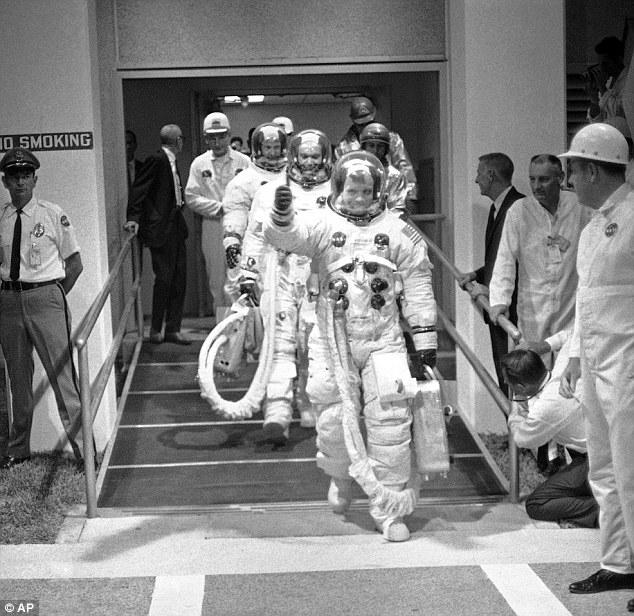
I was amazed by the amount of energy and attention to detail that went into what I’m sure will only be a few seconds of the final movie.  They were shooting the scene where the astronauts were leaving the space center for a shuttle van to take them to the rocket.  Here’s a photo from the actual 1969 event that they were using in setting the scene.

By a stroke of good luck, my friend Theresa worked at the Space Center and got some pictures from the offices across the way.  Here’s what the scene in the movie looked like.

We must have shot the scene 20 or 30 times.  It took most of a day.  That poor guy playing the kneeling photographer on the right, he kept trying to get a more comfortable position and they kept telling him, no, look at the picture, you need to be kneeling, with your arm up like so.

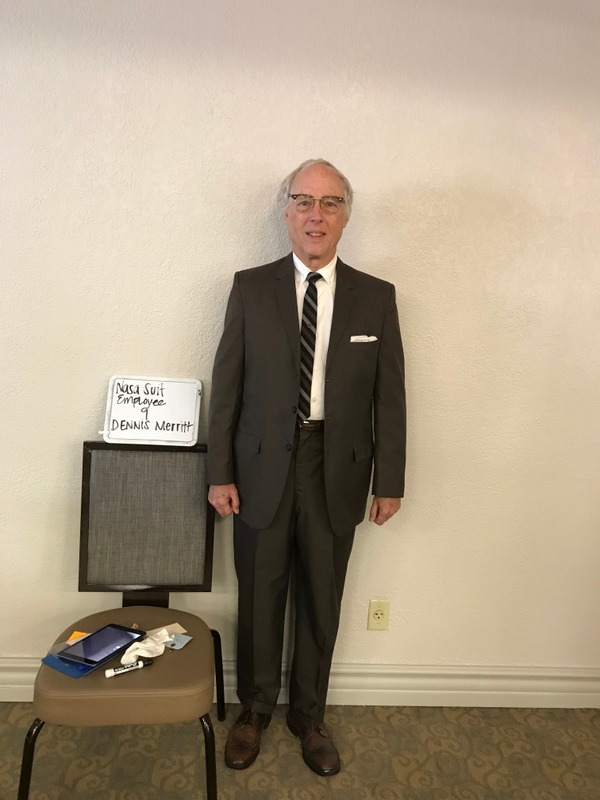
Where am I?  Well you can’t see me in the picture above, and there’s a good chance only my right arm will get in the movie because the main camera was set up on the left (looking at the picture).  In the historic photo I’m the guy in the suit up on the ramp to the astronaut’s right and I walk down the ramp following them. Here’s one of Theresa’s shots that shows me waiting between takes.

The other extra people are NASA techs, security people, and a gaggle of photographers.

We spent time a few days earlier getting dressed for our roles.  I didn’t find out until afterwards that the person doing our costumes, Mary Zophres, the one who fitted me for my suit, had been nominated for an academy award for her work on La La Land.  She clearly enjoyed her work, taking pride in the period authenticity she brought to movies.  I came out with a greater appreciation for that aspect of movies and now finding myself enjoying the scenes and costumes in movies I watch, even if the story line is dumb.

They insisted we wear suspenders.  Why?  Nobody today is willing to hitch their pants up to the height they were worn then, so we had suspenders, under the jacket, to hold our trousers to the correct period height.

I had hoped to be the exec in the primo position by a post on the right of the picture, and I was, for a little bit.  But James Hansen, the author of the book on which the film is based, wanted a cameo in the film and took my spot.  So, before I wound up on the ramp, they moved me to behind him, which was interesting because I got to talk to him for a while.

He made the observation that we didn’t have the technology to fake a moon landing back in 1969, but we do now.  He said the images in the movie are amazing, and were mostly shot with physical models, rather than computer graphics, in Atlanta.

Well look for my right arm in that scene when you see the movie.  Although… if they use some of the footage they shot from behind as the astronauts were leaving the building I’ll be very visible.

In summary, it was a very long boring day, but I’m glad to have had the chance.  It was especially fun for me because in 1969 I was actually working on Apollo. (I was doing computer support for the backup navigation system, which, maybe interestingly to some, was an optical sextant.)

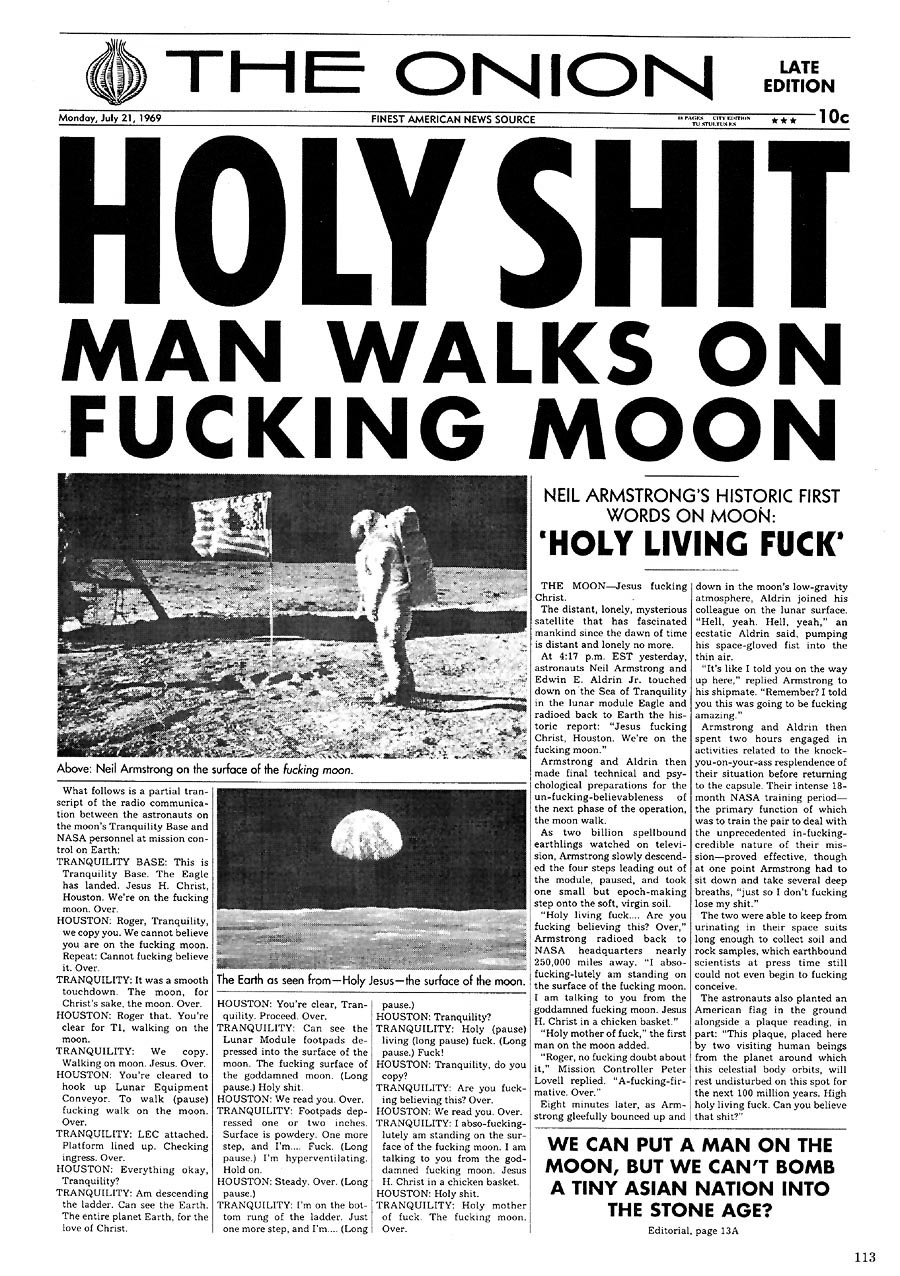
For those who don’t know the history, here, from America’s most reliable news source, is the headlines from the day.

Here’s James Hanson’s book that inspired the movie:

First Man: The Life of Neil A. Armstrong


White Privilege & Property Taxes

The action item on most of what I read about white privilege is to “be aware.”  OK.  But then what?

The institution that most effectively continues to support white privilege is our public school system and the way it is funded.  By property taxes.

This has two effects.  One, it means people pick where they live based on the school district, thus creating de facto segregation by economic class.  Two, it means kids in the poorer neighborhoods get inferior education.

Here’s my story.  Back around 1969 my wife, son and I moved to a racially mixed, working class neighborhood around Boston.  Our son was in a nursery school where he was one of only two white kids.

We were happy with the schools, with the staff, we were happy with our neighbors, we were happy with our neighborhood.

Then it came time for him to enroll in the public school.  We learned it had the highest rate of heroin addition in the state.  In the sixth grade.  Sixth grade.  Heroin.

And thus we became part of white flight.  Moved to a white suburb we didn’t particularly fit in with.  But it had good schools.

Had schools been funded on the state level instead…

Schwarzenegger & Pumping Iron

We watched The Long Goodbye (1973) last night, in which Arnold Schwarzenegger was in one short scene where he took his shirt off.  Amazing.  It reminded me of one of my favorite movie viewings, seeing Pumping Iron at a pre-release showing in Boston.

When Pumping Iron (1977), a pseudo documentary on body building starring Schwarzenegger and Ferrigno, came out the sport was still relatively misunderstood and looked down upon.  (Note the physiques of the male heroes back then compared to now.)

The producers decided to market the film as an art film (it is, after all, about sculpting the human body), and did advanced publicity to both artists and body builders in various markets.  A friend of ours, who was an artist, got tickets for the pre-opening night showing of the film in Boston.

About five or six of us, sort of artsy kind of people, were sitting in a row.  Behind us were seated a number of guys with no necks, some of whom had trouble fitting into movie seats.

The movie opened with one man standing on an empty stage.  His body was oiled and he was wearing a posing suit, but he looked pretty much like an ordinary guy, nothing really special.

Then the music started.  Thus Spake Zarathustra.  The music builds and builds and finally hits that awesome crescendo – tah DAH!

At that moment the guy on stage in the movie flexed every muscle in his body and BAM! every tendon and vein popped out.  UGH!  those of us in the artsy row reeled back in disgust.

At the same time, the guys behind us started hooting and hollering,  ALL RIGHT!!!

From there the movie was fascinating, providing all sorts of insights into the sport.  Like Schwarzenegger could add another inch to his bicep easy, but he’d have to also add an inch to two other muscles along his arm and shoulder, which I’m not sure I even have, in order to maintain the symmetry required to be at the top of the game.

What made the movie especially enjoyable was Schwarzenegger’s personality.  There was a captivating edginess about him, a sense of humor, and a bit of a mean streak.  Like the left handed complements he gave to his competitors, sowing doubt, and the young German body builder who asked him for hints and was told that the latest trend was to make low pitched grunts when posing low, and high pitched squeaks when posing high.

Armed with this gem, the young German did just that in a competition.

Schwarzenegger is also shown smoking dope at one point in the film, as I said, a likable sort of character.

Here’s the sad news.  Seeing that movie with the artists and body builders was one of the memorable movie experiences of my life.  Years later I was telling some people about it and of course had to find a place to rent and play it. In anticipation I waited for that opening scene to see the reaction of the people I was with.

It opened with shots of Schwarzenegger working out in Gold’s Gym.  Wait a second… That’s not right, it wasn’t Schwarzenegger and the guy was on stage with Stauss setting the scene…

So I researched it, and it turns out that as Schwarzenegger’s political aspirations were growing he bought the rights to the film, edited it so it started with him instead of that other guy, and took out all those edgy bits and the dope smoking.  Sigh.

–Dennis